Two Paths Beneath the Sea
- Jun 10
- 1 min read
Canada’s next-generation submarine competition is more than a procurement decision. It also highlights two different approaches to modern conventional submarine technology. South Korea’s KSS-III and Germany’s Type 212CD are both highly capable platforms, yet they emphasize different propulsion philosophies.
Germany’s submarine design is centered on hydrogen fuel-cell Air Independent Propulsion (AIP). By generating electricity through a chemical reaction between hydrogen and liquid oxygen, the system allows the submarine to remain submerged for extended periods without relying on outside air. Because there is no combustion process, fuel-cell systems produce very little noise, making them particularly effective for long-duration stealth operations.
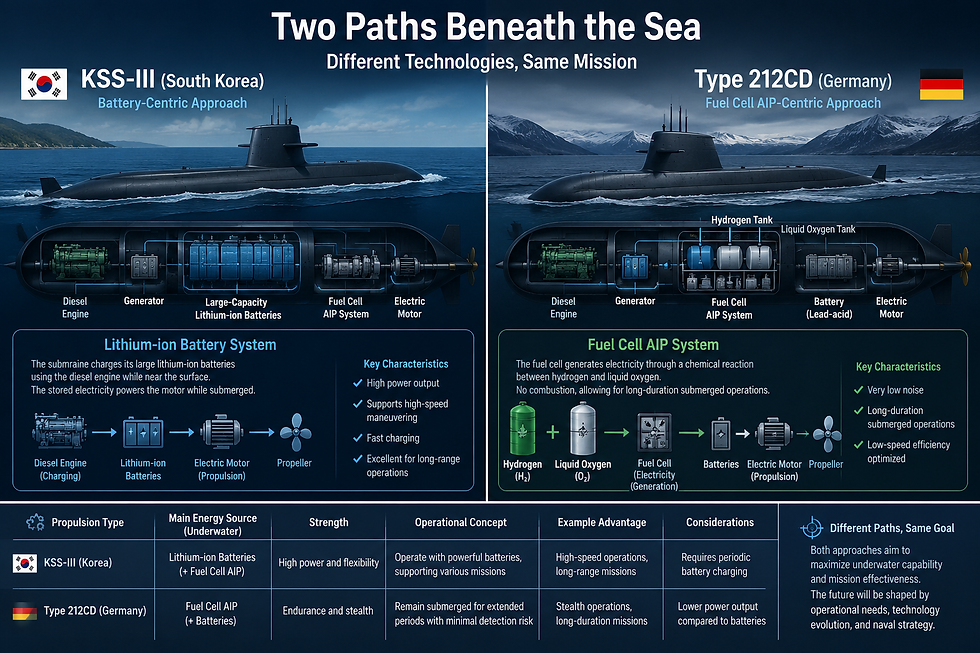
South Korea’s KSS-III, meanwhile, places greater emphasis on large-capacity lithium-ion batteries. These batteries provide higher energy density and stronger power output than traditional battery systems, enabling improved speed, endurance, and operational flexibility. Combined with an AIP system, the design offers both sustained underwater operations and the ability to support higher-performance maneuvering when required.
Neither approach is inherently superior. Fuel-cell technology prioritizes endurance and acoustic stealth, while advanced battery technology focuses on power, efficiency, and future scalability.


Comments