
'Korea' as a Strategic Testbed for Global Digital Governance
Updated: Oct 8
1. Introduction: Korea’s Strategic Market Positioning
Korea is a market whose digital user density and openness to emerging technologies exceed what its population size alone would suggest. The Korean government is currently recalibrating its regulatory framework to establish fair competition in platform markets. This analysis argues that U.S. Big Tech companies should view Korea’s regulatory environment not merely as a constraint, but as a strategic variable for strengthening transparency in service operations and shaping global compliance standards.
2. Market Characteristics: Korea’s Value as a High-Density Digital Testbed
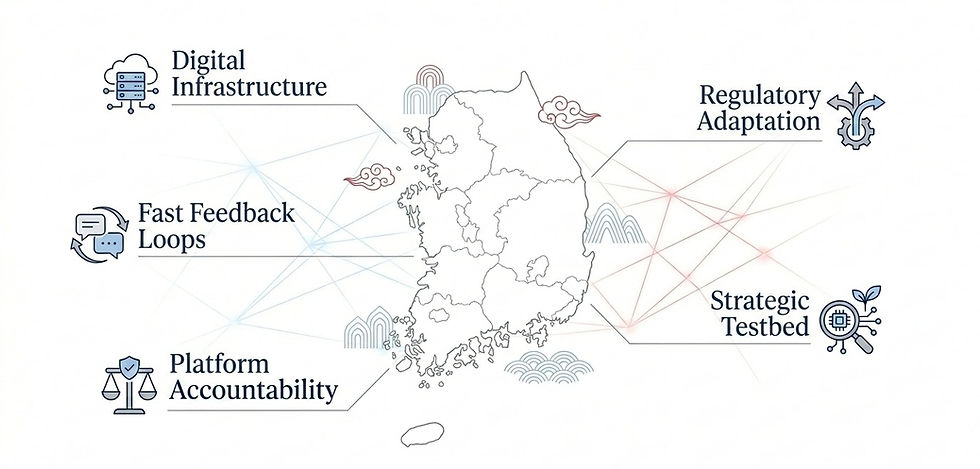
Korea boasts a highly developed digital infrastructure environment, with widespread access to high-speed communications networks and near-universal smartphone use. This enables cloud services, artificial intelligence, and streaming platforms to spread rapidly. In particular, Korea’s fast feedback loops allow companies to test their service models and assess the suitability of localization strategies with a high degree of efficiency. For global firms, this environment offers value as a data-driven testbed where they can evaluate product maturity and assess the scalability of service operations.
3. Regulatory Issues: Strengthening Transparency and Accountability in Platform Operations
Current debates over platform regulation in Korea center on preventing the abuse of market power, ensuring transparency in service operations, and protecting users. For U.S. companies, these developments may increase compliance costs in the initial phase. Over the long term, however, operating services on the basis of clear regulatory guidelines can reduce unnecessary policy friction and help build user trust. In this sense, compliance should be understood as a prerequisite for market entry that protects brand value and enables sustainable business operations.
4. Regulatory Pathway: A Transitional Balance in Digital Norms
Korea’s platform regulatory policy is in a transitional phase as it seeks an optimal policy balance between strong ex ante regulation, such as the European Union’s Digital Markets Act (DMA), and models that place greater weight on market autonomy. Korea is pursuing a moderate and pragmatic approach that aims to encourage fair competition without undermining innovation. Compared with Europe’s more comprehensive regulatory system, this can be seen as an attempt to maintain a relatively market-friendly orientation. For companies, this is meaningful, as it allows for proactive adaptation to a dynamic regulatory landscape.
5. Conclusion: Korea’s Strategic Value as a Middle Ground in Digital Governance
Korea is a key strategic market for U.S. Big Tech companies, where institutional change and market opportunity coexist. Korea’s regulatory environment is forming a distinct “Middle Ground” model between Europe’s more stringent regulatory approach and relatively liberal market models. This model seeks to promote fair competition and build a sustainable digital ecosystem. For successful market entry and long-term positioning, companies need to redefine Korea’s strategic value in the following ways.
Securing a validation hub for global operating models: Korea can serve as a key hub where companies proactively test their global operating models by demonstrating service management capabilities and compliance capacity in a shifting digital regulatory environment.
Building a reference point as a policy milestone: Korea’s pragmatic regulatory approach has value as a reference case for responding to diverse digital policy environments across Asian markets.
Developing digital governance partnerships: U.S. Big Tech companies should use Korea not merely as a market for expansion, but as a space for building core partnerships that support a stable business foundation in digital governance.
Accordingly, proactively adapting to Korea’s regulatory changes and building transparent operating models are essential strategies for maintaining market advantage and exercising policy influence in Northeast Asia’s digital ecosystem.


Comments