
Lessons from Iran’s Drone Warfare and the Case for Stronger USA–South Korea Cooperation
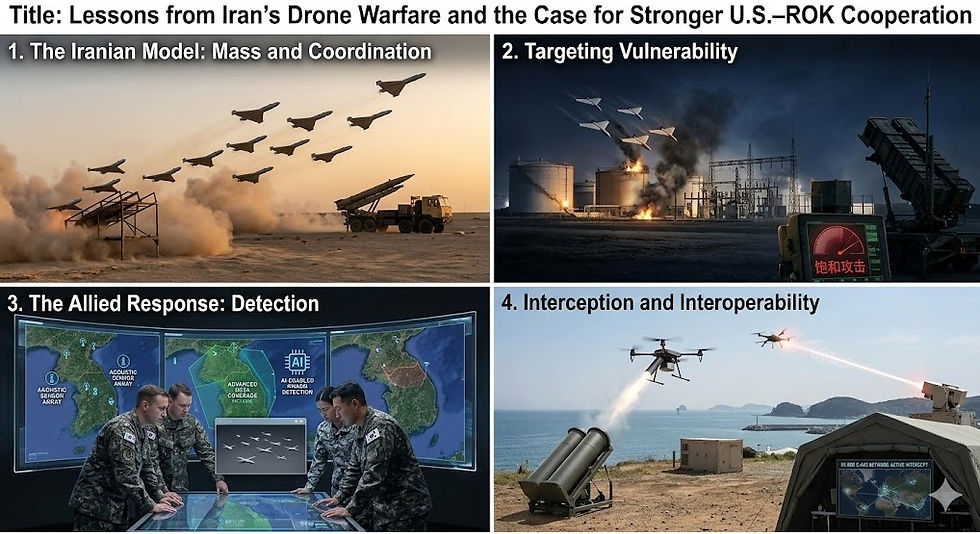
Modern warfare is increasingly defined by the rapid spread of unmanned aerial systems. Once viewed primarily as surveillance tools, drones have evolved into versatile weapons capable of reconnaissance, precision strikes, and large-scale saturation attacks. Recent conflicts have demonstrated that relatively inexpensive unmanned systems can produce significant operational and strategic effects.
One country that has refined this approach is Iran. Over the past decade, Tehran has invested heavily in the development and mass production of low-cost drones designed to operate alongside missiles and other strike capabilities. Rather than relying solely on high-end platforms, Iran’s strategy emphasizes scale, coordination, and cost efficiency.
Recent conflicts in the Middle East have highlighted how this strategy works in practice. Iranian-made drones have been used in coordinated attacks targeting military infrastructure and strategic facilities across the region. In several cases, drones were launched simultaneously with missiles in order to complicate air-defense responses and saturate defensive systems. By combining large numbers of relatively inexpensive drones with other strike assets, these operations demonstrated how unmanned systems can disrupt traditional defense architectures and impose significant operational pressure.
This model of drone warfare has attracted attention far beyond the Middle East. Military analysts note that states facing asymmetric security environments are closely studying these developments. In particular, observers believe that North Korea has shown growing interest in the operational concepts behind such drone strategies, including coordinated drone swarms and the integration of unmanned platforms into broader strike systems.
These developments highlight an important lesson from contemporary conflicts: future air defense will require more than traditional missile-based systems. Effective protection increasingly depends on layered counter-drone networks that combine early detection, rapid response, and cost-effective interception.
Technologies such as acoustic sensor networks, advanced radar systems, artificial intelligence–enabled detection, and autonomous interceptor drones are emerging as essential components of this new defensive architecture. When integrated into a unified network, these tools can significantly improve the ability to detect and neutralize small unmanned aircraft before they reach critical targets.
For allies such as the United States and the Republic of Korea, these technological shifts underscore the importance of deeper cooperation. The USA–South Korea alliance already benefits from decades of close military coordination, joint planning, and technological collaboration. Expanding this partnership into next-generation counter-drone capabilities represents a logical and strategic step forward.
Joint research and development programs, shared testing facilities, and coordinated innovation initiatives could accelerate progress in counter-drone technologies. By combining American expertise in advanced defense systems with Korea’s strengths in electronics, semiconductors, and high-tech manufacturing, the two allies are well positioned to develop scalable and cost-effective solutions.
Strengthening cooperation in this area would enhance not only defensive readiness but also the resilience of the broader alliance. Integrated counter-drone capabilities can help protect critical infrastructure, military installations, and civilian populations from emerging threats while ensuring greater interoperability between allied forces.
As drone technologies continue to evolve, strategic responses must evolve with them. By deepening technological collaboration and investing together in innovative defense systems, the United States and the Republic of Korea can strengthen their alliance while preparing for the security challenges of the emerging drone era.


Comments